
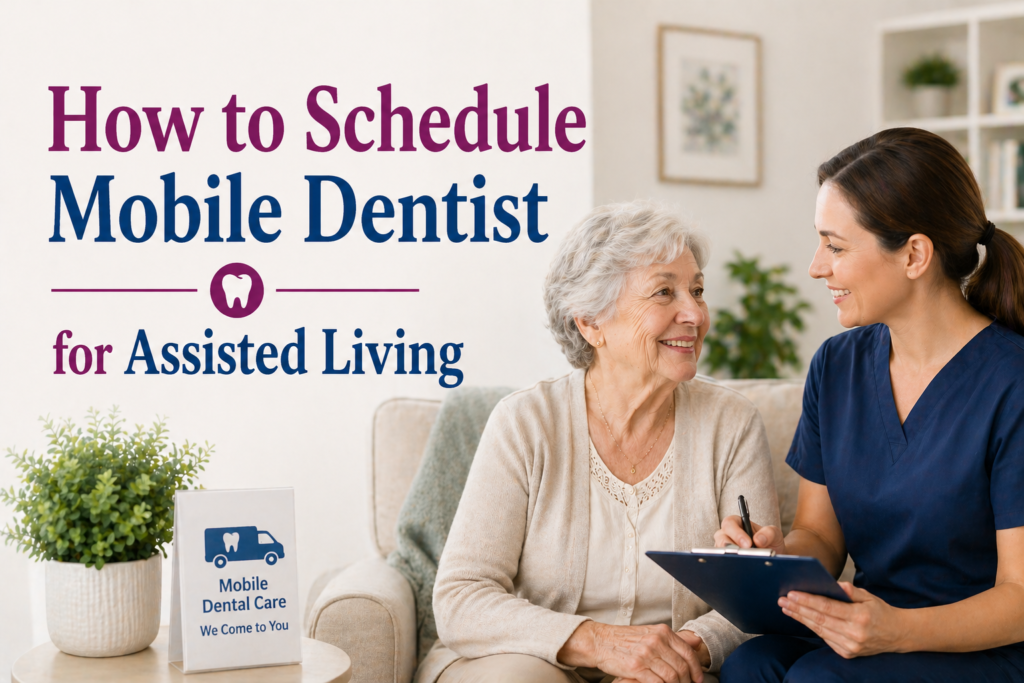
How to Schedule a Mobile Dentist for Assisted Living
If your loved one lives in an assisted living community and dental care has been on your mind, you are not alone. Getting an older adult to a traditional dental office can be genuinely difficult. Transportation has to be arranged. Mobility challenges make the trip exhausting. For someone with dementia, going to an unfamiliar place can cause real distress. And coordinating all of it on top of everything else families are already managing is a lot.
This is exactly why mobile dentistry exists and why more and more families with loved ones in assisted living are turning to it.
A mobile dentist comes directly to your loved one. No car ride. No waiting room. No unfamiliar building to navigate. The dentist brings everything needed and provides care right there in the assisted living community, often in your loved one’s own room.
But a lot of families have no idea how to actually go about scheduling one. This guide walks you through the whole process step by step in plain simple language so you can get your loved one the dental care they need without the stress of figuring it out alone.
What Is a Mobile Dentist and What Can They Actually Do
Before getting into how to schedule one it helps to understand what a mobile dentist actually is and what they can provide.
A mobile dentist is a licensed dental professional who travels to patients rather than seeing them in a traditional office. They carry portable dental equipment including examination tools, digital X-ray equipment, cleaning instruments, and everything needed to provide a solid range of dental services on location.
Mobile dentistry specifically designed for older adults and assisted living residents has grown significantly over the past several years. These providers understand the unique needs of elderly patients. They know how to work patiently with residents who have dementia or anxiety. They are used to providing care in non-traditional settings. And they are experienced at communicating with both the assisted living care team and the patient’s family.
In terms of what services a mobile dentist can provide on location, the list is more comprehensive than most families expect.
Routine dental examinations and oral health assessments are standard. Professional teeth cleanings and preventive care are provided regularly. Portable digital X-rays allow the dentist to get a clear picture of what is happening below the surface. Fillings and basic restorative work can be done with portable equipment. Denture fittings, adjustments, and repairs are commonly handled on location. Tooth extractions when medically necessary can be performed in the assisted living setting. Treatment for dental infections and urgent dental pain is available. Oral cancer screenings are part of routine examinations. And fluoride treatments and other preventive measures are provided as needed.
More complex procedures like root canals, dental implants, or extensive oral surgery typically still require a visit to a fully equipped dental facility. But for the routine care and many common dental issues that older adults face, mobile dentistry handles a great deal without your loved one ever having to leave the community.
Must Read: Does Medicare Pay for Assisted Living Costs Today?
Why Mobile Dentistry Makes So Much Sense for Assisted Living Residents
It is worth taking a moment to talk about why mobile dentistry is often genuinely the better option for assisted living residents rather than simply a more convenient alternative.
For residents with significant mobility challenges, getting into and out of a car, traveling to a dental office, navigating a waiting room, and sitting in a traditional dental chair can be physically exhausting and uncomfortable. For someone who is frail or uses a wheelchair, this is not a minor inconvenience. It is a genuinely taxing experience that some residents simply cannot manage safely.
For residents with dementia, going to an unfamiliar place is often very distressing. Changes in environment can trigger confusion, anxiety, and agitation in people with Alzheimer’s and other memory conditions. Being examined by the dentist in a familiar setting, surrounded by familiar staff and familiar surroundings, is a completely different experience. It is calmer, less frightening, and far more likely to result in successful care.
For residents who have experienced falls or who have significant health conditions, minimizing unnecessary travel reduces risk. Staying within the safe supervised environment of the assisted living community for dental care means one less opportunity for something to go wrong during a trip out.
And for families who are already managing a complex web of medical appointments, care coordination, and daily concerns, having dental care come to the community rather than requiring a separate transportation arrangement is a genuine relief.
Step One, Check With the Assisted Living Community First
The very first thing to do when you want to schedule a mobile dentist for your loved one is to talk to the assisted living community directly.
Many assisted living communities already have an established relationship with one or more mobile dental providers. Some communities have mobile dentists who visit on a regular schedule, coming once a month or once every few months to see residents who have signed up for care. If the community already has a mobile dental provider they work with, scheduling is often as simple as putting your loved one’s name on the list for the next visit.
Ask the community’s care coordinator, director of nursing, or front office staff whether they have a mobile dental provider they work with. Ask how often that provider visits. Ask what the process is for getting a resident added to the schedule. And ask whether there is any cost difference or insurance consideration for using the community’s existing provider versus bringing in a different one.
Even if the community does have an existing provider, you are generally not required to use that specific dentist. But using an established provider who already knows the community and its residents can make the process easier and faster especially for an initial appointment.
Step Two, Ask About Your Loved One’s Existing Dentist
Before searching for a completely new mobile dental provider, it is worth checking whether your loved one’s current dentist offers any mobile or in-facility services.
Some traditional dental practices have expanded to offer mobile visits for long-standing patients who have moved to assisted living or who have difficulty coming to the office. This is not universally available but it is more common than many families realize and it is worth a phone call to ask directly.
Call your loved one’s current dental office and explain the situation. Tell them your loved one has moved to assisted living and ask whether the dentist ever makes facility visits or knows of a trusted mobile dental colleague they could recommend. Even if the answer is no for in-person visits, a trusted referral from an existing dental provider is worth its weight in gold because you know the recommendation is coming from someone who already understands your loved one’s dental history and needs.
If your loved one’s records can be transferred to a new mobile provider, request that the records be sent over before the first appointment so the new dentist has a complete picture of your loved one’s dental history.
Step Three, Search for Mobile Dental Providers in Your Area
If the assisted living community does not have an established provider and the existing dentist does not offer mobile services, the next step is searching for mobile dental providers who serve assisted living communities in your area.
There are several ways to find reputable mobile dental providers.
Ask the assisted living community staff for recommendations even if they do not have an official provider. Staff often know of mobile dental services that other residents’ families have used. Word of mouth within a community is often the most reliable way to find a good provider.
Ask your loved one’s primary care physician or geriatrician. Doctors who treat older adults in the Bay Area are often familiar with mobile dental services in the area and can point you toward reputable providers.
Contact your local Area Agency on Aging. These are regional organizations that help older adults and their families navigate care resources and they often maintain lists of specialty senior care services including mobile dental providers.
Search online specifically for mobile dentists or geriatric mobile dentistry in your area. When you find potential providers, look for reviews from other families who have used their services in assisted living settings. Pay attention to comments about how the provider works with residents who have dementia or mobility challenges.
Ask other families at the assisted living community. If other residents are already receiving mobile dental care, their families can be a great source of firsthand recommendations.
Step Four, Ask the Right Questions Before Booking
Once you have one or more potential mobile dental providers in mind, do not simply book the first available appointment. Take a few minutes to ask some key questions that will tell you whether this provider is the right fit for your loved one.
Ask about their experience working with older adults and specifically with assisted living residents. How long have they been providing mobile dental services to assisted living communities? How many communities do they currently serve? This tells you whether they are truly experienced in this environment or whether they are a general dentist who occasionally makes house calls.
Ask specifically about their experience with dementia patients if your loved one has Alzheimer’s or another memory condition. Working with dementia patients requires specific skills, patience, and techniques that not all dentists have. A provider who has genuine experience in this area will be able to speak to it specifically rather than vaguely.
Ask what services they can provide on location and what would require a visit to a dental office. Understanding the scope of what they can do in the assisted living setting helps you know whether this provider can meet your loved one’s specific needs.
Ask about their equipment. Do they have portable digital X-ray capability? What restorative services can they perform with their portable setup? What does their portable examination setup look like and how does it work in a resident’s room?
Ask how they handle billing and insurance. Do they accept Medicare Advantage plans? Do they work with Medicaid or Medi-Cal? What is the payment process and when is payment expected? Understanding the financial side upfront prevents confusion later.
Ask how they communicate with families after appointments. Will they call or send a written summary of findings and recommendations? How do they handle situations where treatment is needed beyond what they can provide on site? Good communication between the dental provider and the family is essential.
Ask how much notice they need to schedule an appointment and what their cancellation policy is. For a first appointment, many mobile providers need at least one to two weeks of advance notice to get on the schedule.
Must Read: What Is Assisted Living? A Complete Beginner Guide
Step Five, Coordinate With the Assisted Living Community
Once you have chosen a mobile dental provider and are ready to book, you need to coordinate with the assisted living community to make sure everything goes smoothly on the day of the appointment.
Contact the care coordinator or the nursing staff at the community and let them know you are arranging a mobile dental visit for your loved one. Give them the name of the provider and the date and time of the appointment. Ask what they need from you to facilitate the visit.
Find out where in the community the appointment will take place. Most mobile dental visits happen in the resident’s own room which is ideal for comfort and familiarity. Some communities have a designated space for healthcare provider visits. Either way, make sure the logistics are clear.
Ask the community staff to make sure your loved one is awake, comfortable, and ready for the appointment ahead of time. This is especially important for residents with dementia who may need extra time to settle before an examination.
Share any relevant medical information with the mobile dental provider before the appointment including current medications, any health conditions that affect dental care, allergies, and any behavioral considerations the dentist should know about. Many medications commonly prescribed to older adults affect oral health and the dentist needs this information to provide appropriate care.
Make sure the community knows how to reach you on the day of the appointment in case any questions or concerns come up during or after the visit.
Step Six, Consider Whether to Be Present at the Appointment
This is a question many families have. Should I be there for the dental appointment?
For residents who are cognitively intact and comfortable with medical appointments, your presence may not be necessary. But it is always welcome if you want to be there.
For residents with dementia or significant anxiety, having a familiar family member present during the dental appointment can make a real difference. A familiar face and voice can help keep the resident calm and cooperative during the examination. If your loved one tends to become anxious or resistant during personal care or health appointments, being present is worth making the effort for.
If you cannot be there in person, make sure you have a way to connect by phone with the mobile dentist after the appointment to hear their findings and recommendations directly.
Step Seven, Follow Up After the First Appointment
After the first mobile dental visit, follow up promptly to understand what was found and what the recommended next steps are.
If the dentist found dental issues that need treatment, understand specifically what treatment is recommended, whether it can be done on location at a follow-up visit or whether it requires a visit to a dental office, and how urgent the treatment is.
If ongoing care is recommended, establish a regular schedule for follow-up visits. Regular preventive care is far better than only calling the mobile dentist when a problem becomes urgent.
Share the dentist’s findings with the assisted living care team so they are aware of any oral health considerations that affect daily care for your loved one. If the dentist recommended any changes to daily oral hygiene routines, make sure those changes are reflected in your loved one’s care plan.
And if the first appointment went well and the provider was a good fit, keep their contact information readily accessible so scheduling future appointments is easy.
How to Handle Dental Emergencies in Assisted Living
Even with regular preventive care, dental emergencies can happen. A tooth becomes acutely painful. A denture breaks. An abscess develops suddenly. Knowing in advance how to handle a dental emergency in an assisted living setting saves precious time when it matters.
For pain management in the short term, let the assisted living nursing staff know your loved one is experiencing dental pain. They can help ensure appropriate comfort measures are in place while you arrange dental care.
Contact your mobile dental provider as soon as possible and explain that it is an urgent situation. Many mobile dental providers have provisions for urgent visits outside of their regular schedule. Some pain and infection situations genuinely cannot wait for a routine appointment slot.
If the situation is severe and the mobile provider cannot see your loved one quickly enough, contact a local emergency dental clinic or call your loved one’s previous dental office even if they do not typically do mobile visits. For a genuine dental emergency they may be willing to make an accommodation.
Make sure you have your mobile dental provider’s emergency contact information before you ever need it rather than trying to track it down in the middle of an urgent situation.
How Hillmont Senior Placement Helps Families With Dental Care and Placement Questions
At Hillmont Senior Placement we help Bay Area families find assisted living communities that genuinely support their loved one’s complete daily care needs including dental care coordination.
When we are working with a family to find the right community we ask about all aspects of daily care. We find out which communities have established relationships with mobile dental providers. We learn which communities handle healthcare appointment coordination well and which ones leave families to manage everything entirely on their own. And we help families understand what questions to ask about dental care and other daily health needs during community visits.
Finding the right assisted living community means finding a place that takes care of the whole person and oral health is a genuine part of that picture.
Our service is completely free for families. We are paid by the communities when a placement is made.
Must Read: Does My Mom Need Assisted Living or a Nursing Home
Our Services at Hillmont Senior Placement
Full Care Needs Assessment We take time to understand all of your loved one’s care needs including daily health care coordination requirements before recommending any community.
Bay Area Assisted Living Search We search communities throughout the Bay Area and find options that genuinely support ongoing healthcare needs including dental care access and coordination.
Memory Care Placement Support For loved ones with dementia who have specific dental care challenges we find memory care communities with staff trained in supporting oral health for residents with cognitive impairment.
Community Visit Preparation We prepare families with specific questions to ask during community visits including questions about mobile dental services, healthcare coordination, and daily oral hygiene support in the care plan.
East Bay Assisted Living Expertise We have strong knowledge of assisted living communities throughout the East Bay and can help families find communities that handle the full range of daily care coordination well.
Ongoing Support After Placement If dental care coordination or any other daily care concern comes up after your loved one moves in we are still here to help you navigate it.
Frequently Asked Questions About Scheduling a Mobile Dentist for Assisted Living
How far in advance do I need to schedule a mobile dental appointment?
For routine appointments most mobile dental providers need somewhere between one and three weeks of advance notice to schedule a visit. For urgent situations many providers can accommodate faster scheduling. It is worth asking your chosen provider about their typical lead time and their process for urgent care needs when you first make contact.
Does insurance cover mobile dental care in assisted living?
Coverage varies depending on the insurance plan. Traditional Medicare does not cover routine dental care whether provided in a dental office or through a mobile provider. Some Medicare Advantage plans include dental benefits that may cover mobile dental services. Medicaid and Medi-Cal coverage for dental care in assisted living settings varies and is worth checking directly with the insurance provider. Many mobile dental providers are experienced in navigating insurance questions and can help families understand what may be covered before the appointment.
What if my loved one refuses to cooperate with the mobile dentist?
Refusal of dental care particularly in residents with dementia is a real challenge. A good mobile dental provider experienced with older adults will have specific techniques for approaching resistant patients. This might include taking extra time to establish comfort before beginning the examination, using distraction and calm reassuring communication, adapting the examination to what the patient will tolerate on a given day, and being willing to reschedule rather than force an experience that causes significant distress. Discuss this concern directly with the provider before the appointment so they come prepared.
Can the mobile dentist handle denture repairs on location?
Many mobile dentists can perform basic denture adjustments and repairs on location. For more significant denture repairs or for new denture fabrication, a dental laboratory is involved and this typically requires some back and forth that may not be completed entirely on site. Ask your specific mobile provider what their capability is for denture work.
How do I know if a mobile dentist is properly licensed and qualified?
Ask directly for the dentist’s license number and verify it through the California Dental Board website. All practicing dentists in California must be licensed by the state dental board and their license status is publicly searchable. You can also ask about their specific training or certifications in geriatric dentistry or mobile dental services.
What should I do if I am not happy with the mobile dental provider after the first visit?
Finding the right provider sometimes takes more than one attempt. If the first provider was not a good fit for your loved one, ask for feedback from the assisted living staff who observed the visit and look for a different provider. Reach out to Hillmont Senior Placement for guidance if you need help finding better options in the Bay Area.
Is Hillmont Senior Placement free for families?
Yes completely free for families. We are paid by the communities when a placement is made. You never pay us anything.
Getting Started Is Simpler Than It Seems
Scheduling a mobile dentist for your loved one in assisted living is genuinely more straightforward than most families expect once they know the steps. Start by talking to the assisted living community. Check with the existing dentist. Find a qualified provider who has real experience with older adults. Ask the right questions. Coordinate with the community. And establish a regular schedule so dental care does not get overlooked.
Your loved one’s oral health is a real part of their overall wellbeing and quality of life. Dental pain, infections, and neglected oral health affect how people eat, how they feel, and how they engage with daily life. Taking the time to set up good dental care in assisted living is one of those practical acts of love that makes a genuine difference.
Reach out to Hillmont Senior Placement today if you have questions about finding the right assisted living community in the Bay Area or if you need guidance about any aspect of your loved one’s daily care needs. We are here to help.